
Running a Sex Offender Check in Snohomish County
The Snohomish County Sheriff registry entry routes the public to the Washington Statewide Registered Sex Offender and Kidnapping Offender Public Website. The statewide system, often called WASOR, is administered through the Washington Association of Sheriffs and Police Chiefs and receives local law-enforcement registration data. It supports both a named-person search and a location-based search around a home, school, business, or other address.
Use the name mode when checking a known individual. Use the area mode for neighborhood awareness. Public results reflect Washington’s disclosure rules, not every item the Sheriff collects. A missing profile may mean the person is a compliant Level I registrant who is not normally displayed, rather than proof that no registration exists.
Snohomish County Level I Offender Visibility
Washington risk levels describe assessed community reoffense risk. They do not set the length of registration. Level I means low or minimal assessed risk. A compliant Level I registrant is normally absent from WASOR, although out-of-compliance or transient Level I cases may be shown. State law permits some Level I information to be requested from local law enforcement.
Level II and Level III profiles have broader public visibility. Level II is moderate risk and may prompt notice to schools, child-care facilities, libraries, and organizations serving children, women, or vulnerable adults. Level III is high risk and supports broad public and community notification. Always read the level and compliance status on the source profile instead of inferring them from the map position.
Note: No public match is conclusive only within the search and disclosure rules that produced it.
Searching the Washington Statewide Registered Sex Offender and Kidnapping Offender Public Website
Open WASOR through the county Sheriff page or the official statewide address. Search controls may render inside an embedded frame. The official OffenderWatch material confirms an “In your area” search and a “By name” search, but the live interface did not expose fixed radius choices to the research capture. Do not assume a distance that the current form does not show.
- Open the official registry and review its conditions and safety notices.
- Choose “By name” for a known person or “In your area” for an address-based search.
- Review possible matches by name, photo, physical details, location, risk level, and status.
- Open the profile and compare the offense, address disclosure, compliance information, and agency data.
| Control | Type | Required | Use |
|---|---|---|---|
| In your area | Location search | Location details | Search around a home, school, business, or other address |
| By name | Name search | Offender name | Locate a particular public profile |
| Email alert registration | Web form | Email and address | Register one or more addresses for qualifying move alerts |
| Search or Sign Up | Button | Yes | Run the chosen search or save alert enrollment |
Compare more than a name before treating a result as the intended person. The public photo, aliases, physical description, mapped location, offense data, risk level, and status provide the context needed to separate similar names.
Snohomish County OffenderWatch Address Alerts
OffenderWatch lets a user register unlimited addresses for free email alerts. The service sends notice when a Level II or Level III offender moves into a registered neighborhood. A user may also follow one public profile’s address changes. Alert enrollment details, including the submitted email and addresses, are confidential under the program’s official material.
Alerts are a supplement to a current search. They depend on new address and registration data reaching the system, so a resident should open the source profile for current details. If an address change appears relevant to immediate safety, contact the local police department or Sheriff rather than confronting the registrant. The registry’s purpose is informed awareness and practical safety planning.
What a Registry Profile Shows
A public Snohomish County offender profile combines identifying information with the part of the registration file authorized for public release. Registration offices collect more than the website displays. Social Security numbers, fingerprints, and other protected details collected under RCW 9A.44.130 should not be treated as public profile fields.
| Name and Aliases | Public identity names used to distinguish possible matches. |
|---|---|
| Photo and Description | A public image and physical traits useful for identity comparison. |
| Address or Location | Mapped residence or location at the disclosure level allowed by law. |
| Offense Information | Conviction and offense details included in the public registration record. |
| Risk Level | Washington’s assessment category for community-notification purposes. |
| Compliance and Status | Registration or compliance information made public, plus tip or correction controls. |
Read every field together. A photo may age, a person may use an alias, and address disclosure varies. Use the tip or correction channel when a profile appears inaccurate rather than publishing assumptions elsewhere.
Snohomish County Offender Registration Counter
The Sheriff’s registration office is on the first floor of the Snohomish County Courthouse at 3000 Rockefeller Avenue, M/S 606, Everett, WA 98201. The Snohomish County RSO page lists 425-388-3394, while the county directory also lists the Registration Unit at 425-388-3357. Counter hours vary by day and purpose.
- Monday and Wednesday: 9:00 to 11:30 a.m. and 1:00 to 3:00 p.m.
- Tuesday: 9:00 a.m. to noon and 1:00 to 4:00 p.m., for homeless check-in only.
- Thursday: 1:00 to 3:00 p.m.
- Friday: closed.
People without a fixed residence must report in person each week. The current homeless form asks for the location used on each prior day and vehicle identifiers when applicable. Address changes into or out of Snohomish County may use certified mail with the registrant’s name, date of birth, phone, old and new addresses, email when available, and DOC officer when supervised.
Registration Requirements and Levels in Washington
Washington separates community-notification risk from registration duration. Risk Level I, II, or III governs visibility and the Sheriff’s verification target. The conviction class, prior registration history, age in qualifying juvenile cases, and origin of the conviction generally control duration under RCW 9A.44.140.
| Rule or category | Public effect | Period or verification |
|---|---|---|
| Risk Level I | Normally not public unless transient or out of compliance | Sheriff grant target every 12 months |
| Risk Level II | Public website and focused community notice | Sheriff grant target every 6 months |
| Risk Level III | Public website and broad community notice | Sheriff grant target every 3 months |
| Adult Class A or prior qualifying conviction | Duration is not set by risk level | Indefinite, subject to statutory relief |
| Adult Class B, no prior | Qualifying community time applies | Generally 15 consecutive years |
| Adult Class C or listed offense, no prior | Qualifying community time applies | Generally 10 years |
| Qualifying juvenile registration | Age and offense category control | Generally 2 or 3 years |
| Federal, tribal, or out-of-state basis | Washington relief rules must be checked | Indefinite absent statutory relief |
The 12, 6, and 3 month figures are Sheriff verification grant targets under RCW 36.28A.230, not ordinary reporting schedules. A person without a fixed residence has a separate weekly reporting duty.
The official registration-duration statute shown below is the source for the class-based terms and petition provisions.
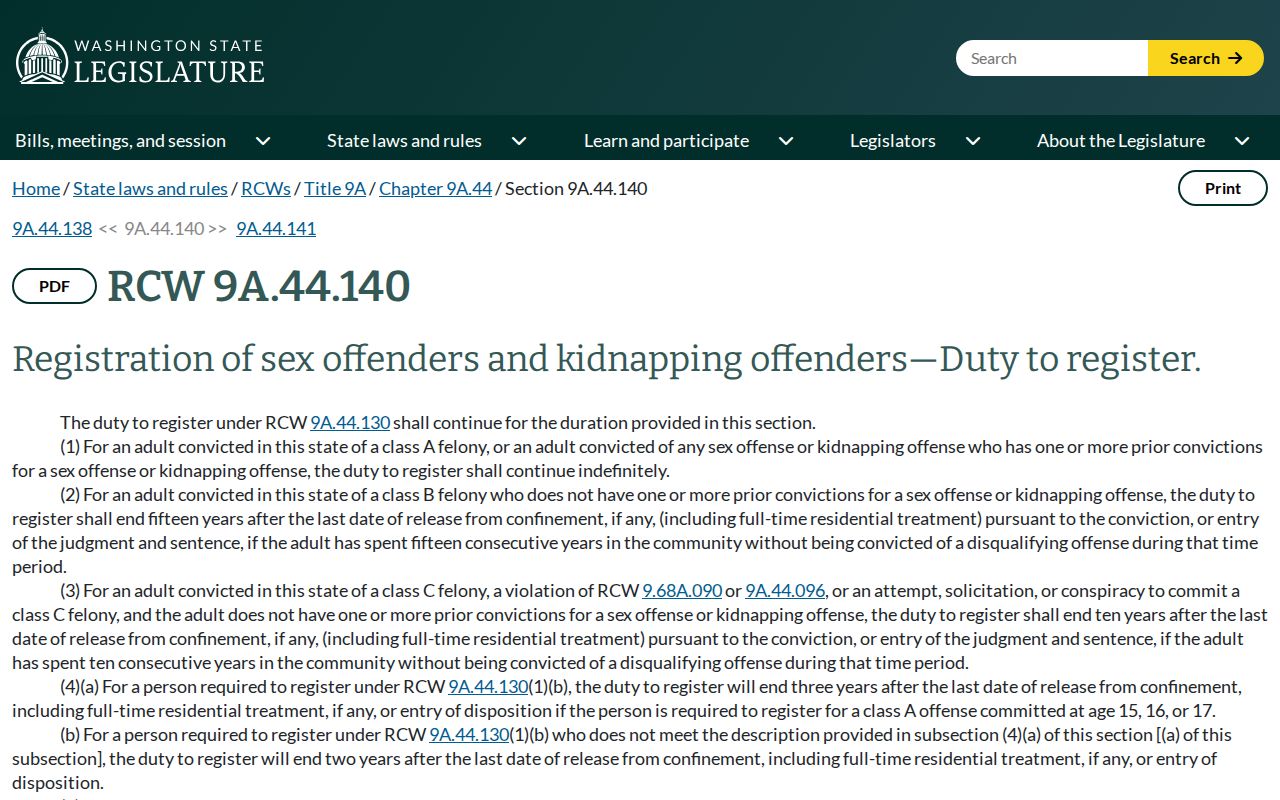
This statute explains why a higher or lower risk level alone does not answer how long registration lasts.
Snohomish County Offender Residence Conditions
Official sources do not establish one blanket Snohomish County distance rule that bars every registrant from living near the same kinds of places. A residence limit may instead come from Washington DOC supervision, juvenile authorities, local probation, or the sentencing court. Those conditions can be individual and time-limited.
Do not infer a violation merely from a mapped address near a park, school, or child-care site. Check the source profile’s status and report a concrete concern to law enforcement. If the question involves a particular court condition, the judgment and supervision authority provide the source terms. Registry risk level, registration duration, and supervision restrictions are three separate concepts.
National Offender Search from Snohomish County
The U.S. Department of Justice National Sex Offender Public Website, or NSOPW, adds a cross-jurisdiction search. It is useful when a person may have lived outside Washington or when a search near the Snohomish County line should include other participating jurisdictions. State and local agencies still supply the underlying information.
The official NSOPW search pictured below should be treated as a national layer, not as a replacement for WASOR or the Snohomish County registration office.
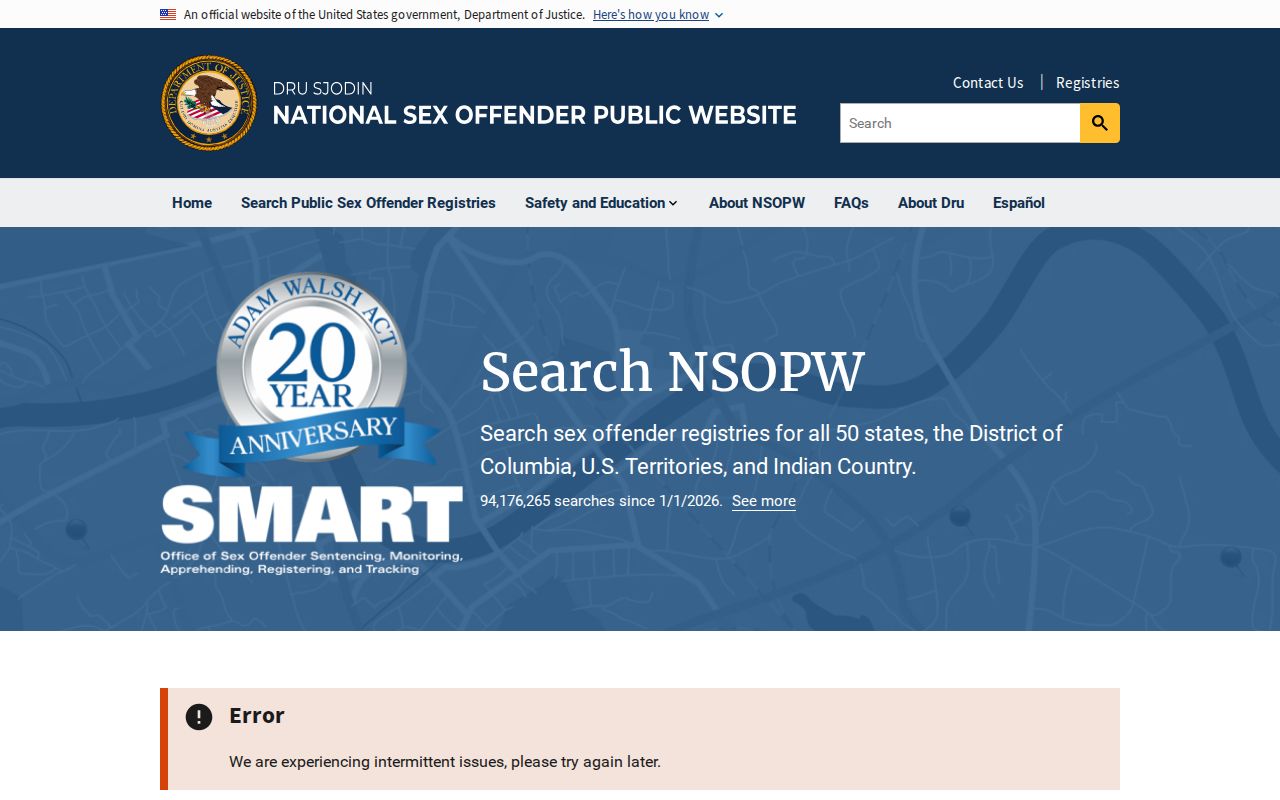
When a national result points to a Washington record, return to the Washington profile for the state’s risk and notification context. If it points elsewhere, use the listed jurisdiction’s official agency record.
Lawful Use and Community Notification
Registry information supports community awareness and safety planning. Under RCW 4.24.550, Washington authorizes public disclosure and community notice based on risk and public-safety needs. The law’s community-notification framework is shown in the official source image below.
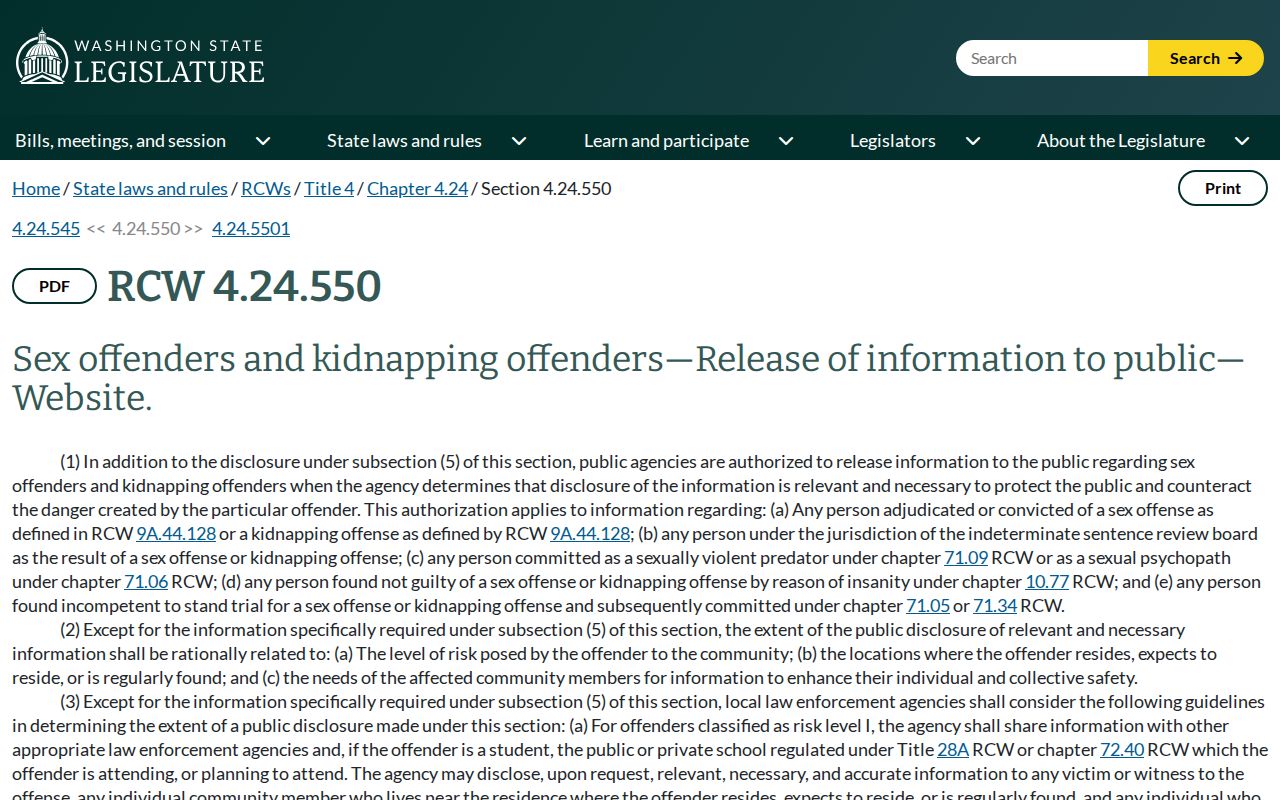
Use the profile to plan, subscribe to alerts, or give a specific tip to law enforcement. Do not contact or confront a registrant. The Sheriff and WASPC warn that threats, intimidation, harassment, vandalism, or violence may lead to prosecution and can undermine the notification program.
Misuse warning: Harassing, threatening, intimidating, or harming a registrant or household because of registry information may be prosecuted under Washington law.
Snohomish County Registration Duties and Reports
RCW 9A.44.130 governs Washington registration procedures. The official statute image below anchors the duty to report the identifiers and location information that law enforcement maintains.
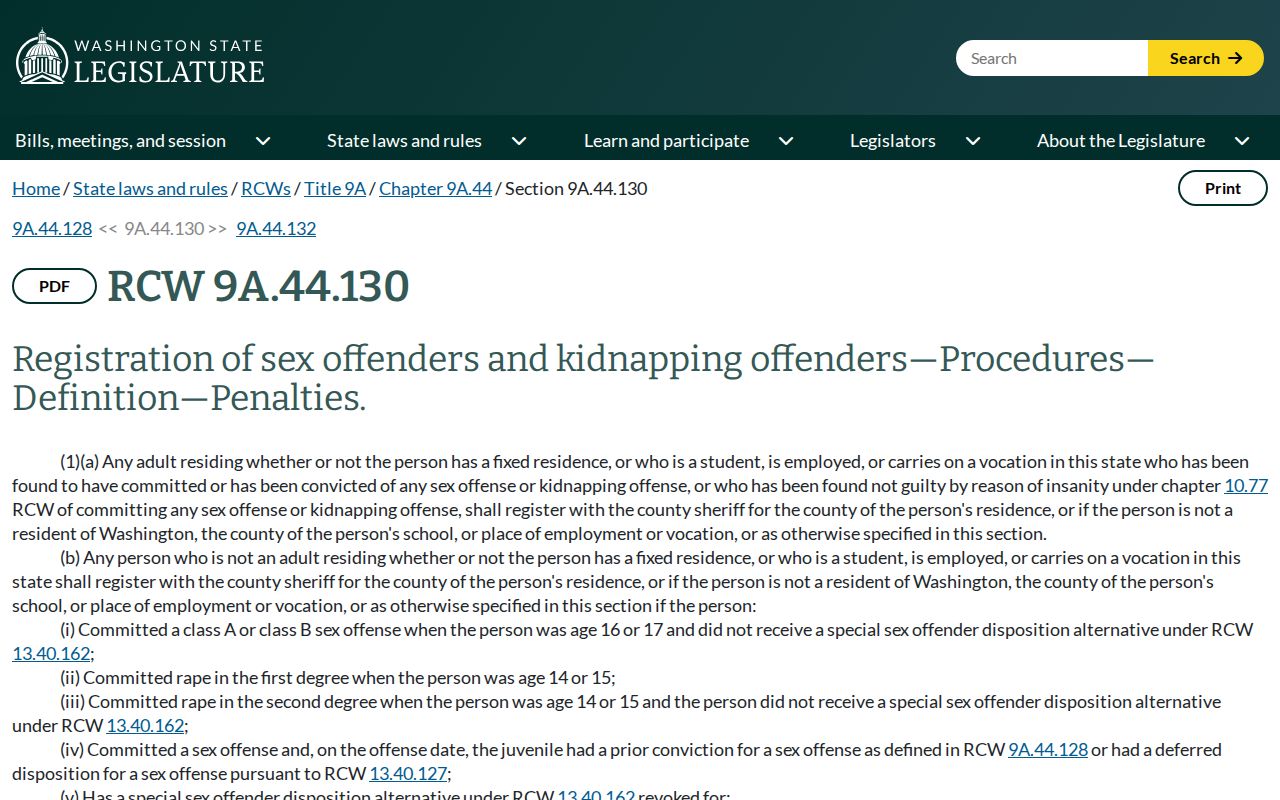
The public profile is only the disclosed part of that law-enforcement file. If a registrant seems out of compliance, note the source profile, location, time, and observed facts. Contact the local police agency or the Snohomish County Sheriff’s Office. For an emergency, use emergency services. Do not investigate in person, post private claims, or try to enforce registration duties yourself.
Note: A tip is most useful when it states observable facts and identifies the exact official profile involved.