
Criminal Cases in the Snohomish County Courts
Snohomish County criminal court cases divide by jurisdiction. Snohomish County Superior Court and the County Clerk maintain felony causes. District Court and city municipal courts keep limited-jurisdiction files for misdemeanors, gross misdemeanors, traffic matters, and local ordinance cases they hear. The court named on the docket controls where a complete file or certified copy must be requested.
That division matters even on the Everett government campus. The courthouse, county jail, Everett police office, and Everett Municipal Court are close to one another, but each holds a different record. A Sheriff arrest report does not become the official case file. Likewise, a jail intake charge can differ from the information or complaint later filed by a prosecutor. Match the cause number, court, filing date, and party before relying on a result.
Snohomish County Case Jurisdiction
The quickest routing test is the alleged offense and filing court. Superior Court is the felony trial court. Snohomish County District Court and the municipal courts hear the limited matters assigned to them. A person name may produce several results across those levels, so court location and cause number are more reliable than a name alone.
The District Court and District Court Clerk service page is the live route for limited-jurisdiction records and warrant information. Its access path is changing as Washington moves those courts toward Enterprise Justice and eFileWA in 2025 and 2026. Saved links can age. Start from the current court page, then confirm which division owns the Snohomish County criminal case.
Jurisdiction check: felony filing › Superior Court and County Clerk; misdemeanor filing › District or municipal court; appeal › the court shown in the appellate index.
How to Search Case Records
Begin with Washington Courts Case Search. It indexes municipal, district, superior, and appellate matters and updates daily around 3:00 a.m. The service is a reference index, not the official record. Use it to locate the court and cause number, then move to the clerk or to Odyssey for Snohomish County Superior Court case information.
- Choose a case-number, person-name, or court-date search based on what you already know.
- Select the court level or Snohomish County location and enter the exact cause number when available.
- For a name search, compare the first name, last name, filing date, court, and case type before opening a result.
- Use Odyssey Portal for anonymous Snohomish Superior Court case information when the matter participates.
- Ask the court of record for the filed document, audio, or certified copy needed.
| Interface | Search fields | Best use | Limit |
|---|---|---|---|
| Case Search, case | Court level, location, case number | Exact cause lookup | No case documents |
| Case Search, person | Last name, first name, narrowing identifiers | Finding possible cases | Common-name matches need review |
| Case Search, court date | Name, court, date | Checking a calendar entry | Schedules can change |
| Odyssey Smart Search | Record number or name, advanced filters | Superior Court case information | Anonymous users cannot open documents |
The official Washington search interface shown below illustrates why the statewide index is the first stop for a Snohomish County case reference.
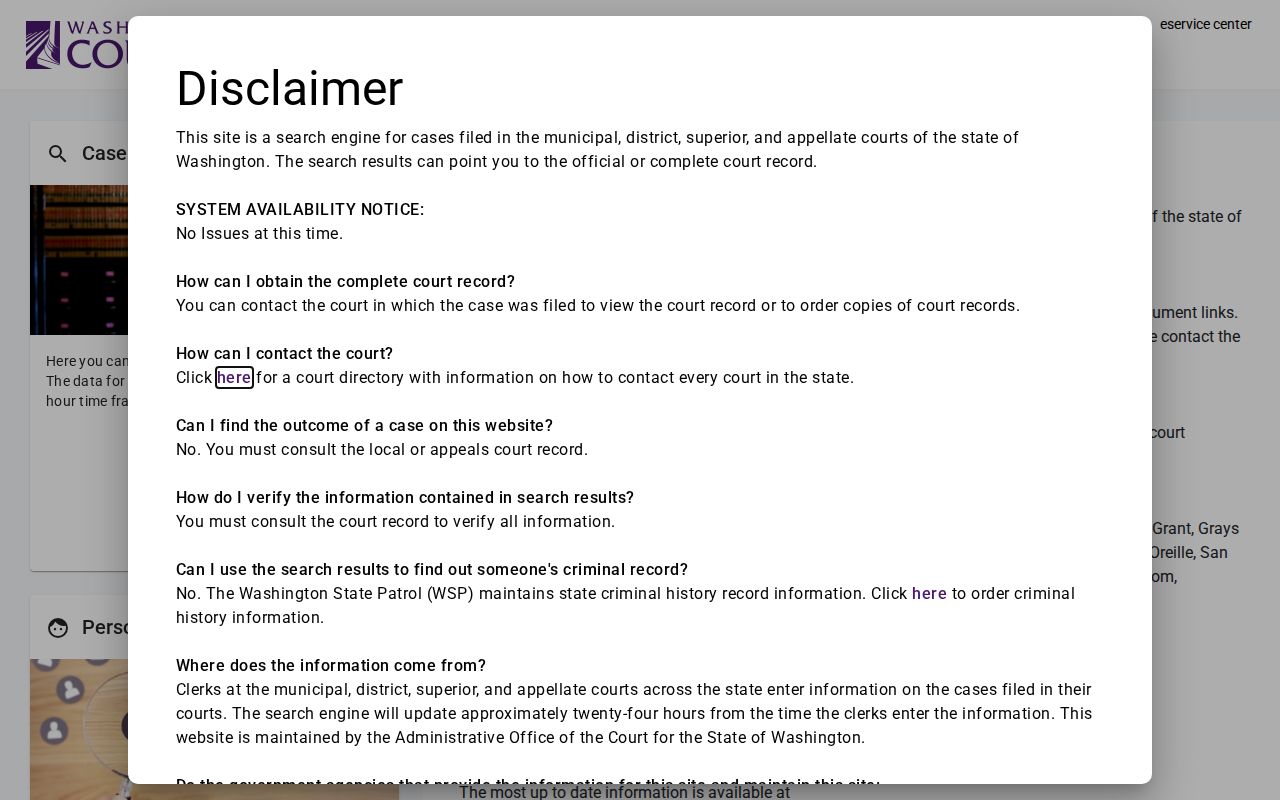
Once the result identifies the court, the clerk at that court supplies the source file rather than the statewide index.
Snohomish County Odyssey Case Records
Odyssey adds anonymous case information for participating Superior Courts, including Snohomish County, but it does not turn anonymous access into document access. A public user may find the case heading, parties, status, events, and other indexed details while the linked pleading or order remains unavailable. Registration alone does not guarantee documents. County Clerk authorization and the user’s access role control that layer.
This distinction often explains a result that appears complete at first glance. A docket entry may say that an order was filed without showing the order’s text. Restricted cases do not appear in the anonymous view. When the needed item is absent, note the cause number and exact docket description, then contact the Snohomish County Clerk. Older or nondigitized files may also require clerk or Records Center help.
Note: An online event line proves that an entry exists, but only the filed document shows its full terms and signatures.
What the Case File Shows
A Snohomish County criminal case file follows the prosecution after filing. The most useful entries establish what the prosecutor charged, what the court heard, how each count ended, and what sentence followed. Read the docket in date order. Later orders can amend an earlier charge, reset a hearing, dismiss a count, or correct a judgment.
| Cause Number and Court | The unique case identifier and the court that owns the official file. |
|---|---|
| Charging Document | The complaint or information stating the allegations filed by the prosecuting authority. |
| Docket Entries | A dated list of filings, hearings, orders, pleas, and other court events. |
| Hearings | Dates, times, hearing types, and the judicial officer where the system displays them. |
| Disposition and Judgment | The outcome for each charge, such as conviction, acquittal, or dismissal. |
| Sentence and LFOs | Custody, community terms, restitution, and legal financial obligation references in the judgment. |
A case index can omit protected identifiers and confidential documents. It also does not contain every police attachment. For the incident narrative or evidence held by an agency, use that agency’s public-record channel instead of asking the Clerk to recreate the police file.
GR 31 and Snohomish County Cases
Washington draws a firm line between agency records and court records. The GR 31 court-access rule governs Snohomish County case files. The Washington Public Records Act governs identifiable records held by executive agencies such as the Sheriff. Sending a PRA request to the Sheriff for a filed judgment reaches the wrong custodian.
GR 31 supports public access while allowing restrictions tied to privacy, court orders, and undue burden. Juvenile matters, sealed files, victim data, health records, financial identifiers, and other protected material may be hidden or redacted. An anonymous search that returns nothing does not prove that no case exists. Confirm the spelling, court level, filing window, and possible restriction with the clerk.
Record rule: Use GR 31 and the court clerk for the Snohomish County criminal case file; use chapter 42.56 RCW for Sheriff or police agency records.
Stages of a Criminal Case
A Snohomish County court file begins when the prosecutor files a complaint or information. Arraignment formally presents the charge and records a plea. Pretrial entries may address discovery, release, motions, continuances, or negotiated changes. The case then moves to a plea or trial, followed by a disposition. A conviction leads to a judgment and sentence, while dismissal or acquittal ends the affected count without a conviction.
Case flow: Charges Filed › Arraignment › Pretrial › Plea or Trial › Disposition › Sentencing
The docket can show several outcomes in one Snohomish County criminal case. One count may be amended, another dismissed, and another resolved by plea. Read the disposition at count level and review the final judgment. An arrest-era booking label is not a substitute for that sequence.
Snohomish County Court Record Copies
Search tools help identify the file, but copies come from the court of record. The Snohomish County District Court fee schedule publishes a charge of $0.50 per page for court records. A certified District Court copy costs $5 for the first page plus $1 for each added page. Audio from a court hearing is listed at $20 per hearing date or CD. Confirm Superior Court Clerk charges under its current schedule before ordering.
Give the clerk the cause number, court division, document title, and filing date when possible. Those details reduce the chance of receiving the wrong order in a case with many entries. Ask whether an older file is digitized and whether inspection is available before paying for a large copy set. Certification is useful when an authentic clerk-stamped copy is required; an index printout is not the same product.
Note: The court’s copy charge does not apply to a separate Sheriff incident report or jail administrative record.
Access & Restrictions
Open access to Snohomish County criminal court records has limits. Sealed court files and restricted cases are not exposed through public search. Juvenile cases follow separate rules. Public views may omit birth dates, account numbers, medical material, protected victim information, and documents sealed by order. A clerk can explain the access process but cannot release material that the law or a court order withholds.
If a case is missing, first check the exact name and cause number, then search municipal, District, and Superior Court levels. Allow for the statewide index’s daily refresh. Ask the court of record whether the case is older, nondigitized, restricted, or stored under another identifier. For broader context on the arrest that preceded a filing, the county’s arrest history channels identify the jail and agency records that remain outside the court file.
Missing Snohomish County Case Documents
An online Snohomish County docket without a viewable PDF is normal, especially for anonymous Odyssey users. Record the court name, cause number, party name, entry date, and exact title of the document. Then contact the County Clerk for a Superior Court cause or the District or municipal clerk named in the index. Request only the needed entries when a file is large.
If the clerk cannot locate the case from a name, supply the cause number and filing year. If the record was sealed, public staff may confirm only what the governing rule permits. If the desired item is a police narrative, body-camera file, dispatch log, or booking record, redirect the request to the arresting agency, SNO911, or Corrections. The custody map keeps a Snohomish County case search from ending at the wrong counter.